





What does the WLL stamped on a hoist, sling or shackle actually mean - and can you trust it?
Rigging · Explainer
Updated 22 Jun 2026
Rigging
Load ratings
What is WLL? Your gear's safe limit.
Working Load Limit is the number that says how much a piece of gear can safely carry. Here's how it is set, how it differs from SWL, and why a rated number beats a guess every time.
WLL is the most you can safely hang. The maker sets it with a safety factor already built in.
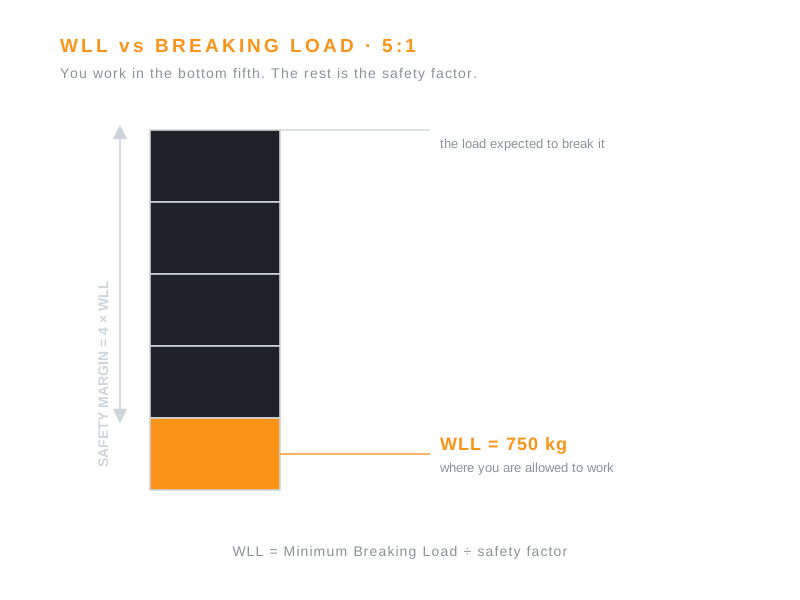
WLL = breaking load divided by a safety factor, usually 5:1 or more. A 750 kg part breaks near 3,750 kg.
A marked, tested WLL is a calculated boundary, not a hunch. That is the whole point of the rating.
The breaking load is what the gear can take. The WLL is what you are allowed to hang - and the gap between them is there on purpose.
WLL, SWL, MBL. One safe ceiling.
Load ratings come with their own alphabet. The three you will see most are WLL, SWL and MBL, and they all describe the same idea from different angles: how much load is safe, and how much would break the gear. Get these straight and a spec sheet stops being a cipher.
The cards below are the three you need; the table adds the two you will occasionally meet - UDL and ELL. For how a sling's rating changes once you actually hitch it to a load, see our companion guide on reading a sling tag.
WLL
The maximum load a piece of gear is rated to carry in normal use, with the safety factor already applied. The headline number on a hoist, sling or shackle.
Set by
The manufacturer, safety factor already applied.
Means
The safe ceiling for the load.
Note
The current, standard term on most product ratings.
SWL
The safe load for an item in a given configuration. In most theatre contexts it means the same as WLL - the safe ceiling for the load.
Where you see it
On some inspection certificates.
Vs WLL
Usually the same; can be a lower in-situ figure for one rig.
Note
WLL is the more current term.
MBL
The load at which a component is expected to fail. WLL is derived from MBL by dividing it by the safety factor.
Means
Where the gear is expected to give way.
Relation
WLL = MBL divided by the safety factor.
Note
You never load to MBL - that is the margin.
| Term | Stands for | What it tells you |
|---|---|---|
| WLL | Working Load Limit | The maximum safe load in normal use, safety factor already applied |
| SWL | Safe Working Load | The safe load in a configuration; in theatre usually the same as WLL |
| MBL | Minimum Breaking Load | The load expected to cause failure; WLL is derived from it |
| UDL | Uniformly Distributed Load | A safe load spread evenly across a span, such as a truss or bar |
| ELL | Entertainment Load Limit | A European adjustment of WLL for event conditions; not used in Australia |
The break load, divided down.
Here is the whole formula: WLL = Minimum Breaking Load divided by a safety factor. The safety factor is the margin the industry builds in so that normal use stays well clear of failure. In entertainment rigging it is commonly 5:1 or higher.
A worked example makes it concrete. A coupler marked with a 750 kg WLL at a 5:1 safety factor is not expected to fail until around 3,750 kg - five times its rated limit. The 750 kg is not where it breaks; it is where you are allowed to work.
That gap is deliberate, and it is why you never rate gear by eye. The number on the tag is a calculated, tested boundary. A guess has no factor behind it.
WLL is not the only number on the tag.
Once you have WLL, the rest of the alphabet falls into place:
- SWL is the older word for the same idea. Safe Working Load and WLL both mean the safe ceiling. WLL is current; SWL lingers on some certificates and can be a lower in-situ figure for a specific rig.
- MBL is the break point, not a working number. Minimum Breaking Load is what WLL is calculated from. You never load to it - the safety factor is the whole space between MBL and WLL.
- UDL is a spread load, not a point load. Uniformly Distributed Load is how a span's limit is written - so many kilos per metre, spread evenly. Concentrate that same weight at one point and the safe figure drops.
- ELL is European, and not an Australian requirement. Entertainment Load Limit adjusts WLL for crowd movement and vibration. Worth knowing, but do not apply it as an AU rule.
One rule sits over all of them: an assembly is only rated to its weakest part. A 2-tonne sling on a 1-tonne shackle is a 1-tonne assembly. Rate the whole pick by its lowest-rated component, every time.
A rated number beats a guess.
The reason load ratings exist is simple to state: a hunch is not a number. A marked WLL is a tested, calculated limit with a known margin behind it. A guess has neither - and the load does not care how confident anyone was.
This matters most where the consequences are highest and the experience is lowest - school halls, community stages, multipurpose venues. Knowing the actual rating of every piece of gear prevents failures, protects the crew, and meets the legal standard.
So the rule is plain: if it is not marked, do not trust it. Unrated gear has no WLL because nobody calculated one. Get it rated, or take it out of service.
Every item we hang carries its number.

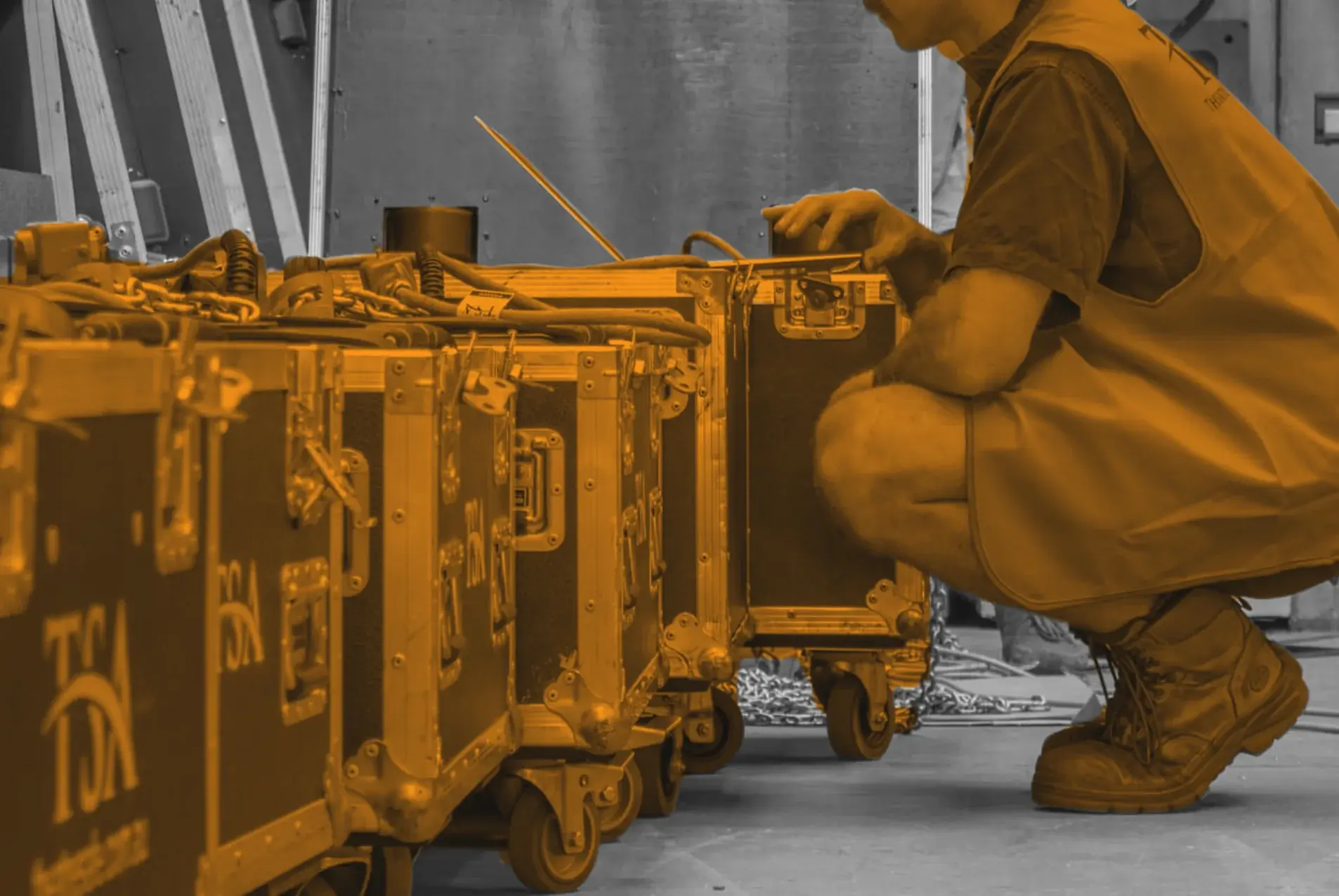
Everything TSA stocks and rigs is load-rated, marked and traceable - a WLL on the tag, a test certificate behind it, and a serial number that follows it through every inspection.
When our service team inspects a venue, that is half the job: confirming each asset still meets its rating and tagging anything that does not. The result is an inventory where every number on the rig is one you can stand under. It ties back to our Venue Systems Health Check.
We've got the ratings. You've got the show.
Not sure what your gear is actually rated to?
Book the team
Quick reference
Book a Systems Health Check.
We confirm every piece of stage gear against its rating, tag what passes, flag what doesn't, and hand you documented proof. Australia wide.
Book the checkWLL chart for fly systems.
A fast lookup for the working load limits across a theatre fly system - bars, lines and hardware.
Open the WLL chart